Third graders at HSES have been reviewing notes and rests. We reviewed the rhythms we learned earlier in the year and just added in sixteenth notes. I've recently gotten a trial of Quaver to use in my classroom and so I looked to see what was available for teaching sixteenth notes. Quaver's "Sixteenth Note Samba" is SO catchy and my students LOVED it.
Also, I don't think I've ever had a group of students catch on so quickly to counting sixteenths. :) Here they are working with partners to create, notate, and perform rhythms with sixteenth notes.
Welcome to the HSES Music Room Blog! We hope you check in with us often to find out what our marvelous musicians are learning!
Showing posts with label Rhythm Review. Show all posts
Monday, January 21, 2019
Thursday, September 6, 2018
Rules and Rhythms - Updated!
Rules and Rhythms has become my favorite back-to-school lesson! It is the perfect way to review our music rules and expectations while also practicing rhythms and having fun! This year, I tweaked the lesson a little and the students did a great job and seemed to really enjoy it.
First, each group was given one of our music rules and they had to notate the rhythm using their rhythm cards.
Next, the groups were asked to create a body percussion pattern to perform their rhythm. They used creative combinations of snapping, patting, stomping, clapping, and more. After some practice, each group performed their body percussion and rule for the class to a beat track. This is the track we used and it worked really well: https://www.youtube.com/watch?v=anCq5XLnnKY
Finally, we had each group perform their body percussion at the same time while saying their rule out loud (using the beat track). So much fun! Now, the students know our music rules and they are ready for our rhythm unit!
First, each group was given one of our music rules and they had to notate the rhythm using their rhythm cards.
Finally, we had each group perform their body percussion at the same time while saying their rule out loud (using the beat track). So much fun! Now, the students know our music rules and they are ready for our rhythm unit!
Friday, August 26, 2016
Alexander and the Rhythm/Instrument Review!
One of my favorite children's books is the classic, Alexander and the Terrible, Horrible, No Good, Very Bad Day, by Judith Viorst. Artie Almeida has a wonderful lesson plan in her book, Mallet Madness, that serves as a great review activity for the beginning of the year! Not only does it review basic rhythms but you can also use it for an instrument technique refresher as well. Our HSES 2nd graders have really enjoyed this activity as we have gotten back into the swing of things in music class.
First we read the story together...
Next, we reviewed the quarter note, eighth notes, and quarter rest, and then I had the students discover the rhythm of the repeated phrase in the book, "...terrible, horrible, no good, very bad day."
I divided the students into 4 groups and each group practiced one part of the phrase. Then each group played their rhythm on their instruments and we put the phrase all together.
The woodblocks:
The tambourines:
The maracas:
The drums:
Then I read the book again, and each group played the rhythm on their instrument on the correct words. Great job, 2nd graders!
Friday, March 25, 2016
The Mitten
One of my absolute favorite lessons each year goes along with the children's book, The Mitten, by Jan Brett.
I got this idea from my mentor teacher years ago and have adapted it and tweaked it over the years. I use it as a way to culminate the major units that my first graders have been studying throughout the year - rhythm patterns and basic mallet skills. It is also a great way to ease them into preparing for their Spring Musical.
First, I read the story to the students and we discuss the various characters in the book. For each character, we learn a rhythm pattern and I have the students practice playing the rhythms on various percussion instruments.
Then, I teach the students a song that goes with the book. We add a simple bordun and an octave glockenspiel part at the end of each phrase.
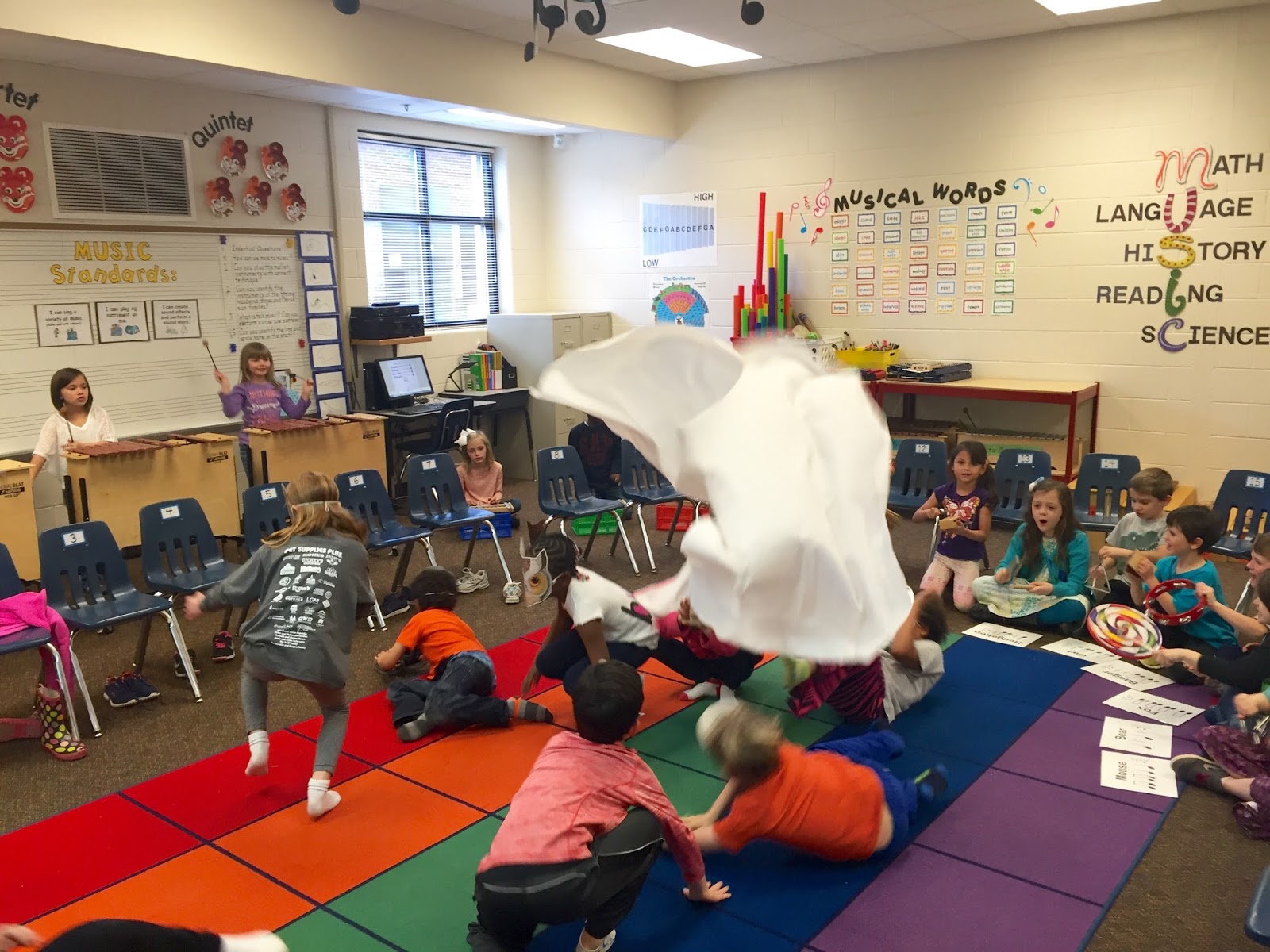
Finally, we add some actors! I choose students to represent each character and they follow the narration of the book. I created some masks that I printed from Jan Brett's website, laminated them, and added some elastic bands.
I used a cheap white sheet and cut it into the shape of a mitten for the actors to sit on top of during their performance.
After the students have practiced all of the parts, we put together a performance that we show to their classroom teacher. As the story is read, one student plays the rhythm pattern on the percussion instrument while that character "gets into" the mitten. When the bear sneezes in the story, the actors toss the mitten up into the air and pretend to fall into the snow while the percussionists play all together. We begin and end the performance with our mitten song accompanied by the mallet instruments.
If you have larger classes, you can add actors for Nicki and his grandmother, Baba. You can also double instrument parts and even add sound effects on the sneeze part (think: crank, vibraslap, slapstick, etc.) This activity makes a great "informance" piece at PTO meetings or other school events.
The students LOVE it and it is definitely a crowd-pleaser for teachers, too. Fun and learning - that's how we roll at HSES! :)
I got this idea from my mentor teacher years ago and have adapted it and tweaked it over the years. I use it as a way to culminate the major units that my first graders have been studying throughout the year - rhythm patterns and basic mallet skills. It is also a great way to ease them into preparing for their Spring Musical.
First, I read the story to the students and we discuss the various characters in the book. For each character, we learn a rhythm pattern and I have the students practice playing the rhythms on various percussion instruments.
Then, I teach the students a song that goes with the book. We add a simple bordun and an octave glockenspiel part at the end of each phrase.
Finally, we add some actors! I choose students to represent each character and they follow the narration of the book. I created some masks that I printed from Jan Brett's website, laminated them, and added some elastic bands.
I used a cheap white sheet and cut it into the shape of a mitten for the actors to sit on top of during their performance.
After the students have practiced all of the parts, we put together a performance that we show to their classroom teacher. As the story is read, one student plays the rhythm pattern on the percussion instrument while that character "gets into" the mitten. When the bear sneezes in the story, the actors toss the mitten up into the air and pretend to fall into the snow while the percussionists play all together. We begin and end the performance with our mitten song accompanied by the mallet instruments.
If you have larger classes, you can add actors for Nicki and his grandmother, Baba. You can also double instrument parts and even add sound effects on the sneeze part (think: crank, vibraslap, slapstick, etc.) This activity makes a great "informance" piece at PTO meetings or other school events.
The students LOVE it and it is definitely a crowd-pleaser for teachers, too. Fun and learning - that's how we roll at HSES! :)
Thursday, November 5, 2015
Shut the {Music} Box!
My 3rd grade students have been working on remembering their note values. We've played several games recently to help them work on this skill, including "Rhythm War." After finding the "Shut the Box" game on Pinterest, I decided to give it a whirl and my students have really enjoyed it!
To play, students work with partners and take turns trying to mark off as many numbers in their row as possible. They roll the dice and can either mark off the note values separately or add them together. For example, if they rolled a half note and a quarter note, they could mark off a 2 and a 1 or they could add them together and mark off 3. The object of the game is to get the most boxes crossed off.
(You can see the original blog post at Notable Music Studio and print off the game board here: http://sherylwelles.blogspot.com/2013/05/shut-box.html)
To play, students work with partners and take turns trying to mark off as many numbers in their row as possible. They roll the dice and can either mark off the note values separately or add them together. For example, if they rolled a half note and a quarter note, they could mark off a 2 and a 1 or they could add them together and mark off 3. The object of the game is to get the most boxes crossed off.
(You can see the original blog post at Notable Music Studio and print off the game board here: http://sherylwelles.blogspot.com/2013/05/shut-box.html)
Monday, October 26, 2015
Tennis Ball Rhythms
To go along with our Rhythm unit, 4th and 5th graders have been talking about subdividing and how music note values are related to fractions.
Classes have really enjoyed this tennis ball rhythm activity! Each note has a different movement that goes with it to represent that note value. It helps to reinforce steady beat, how the notes are related to each other, and how they fit in the measure. Here are some pictures of the students practicing:
Whole Note: tennis ball goes around the body in a large circle for 4 counts
Half Note: bounce tennis ball for 1st count and catch ball for 2nd count
Quarter Note: toss the tennis ball up and catch on each beat
Eighth Notes: toss the ball back and forth between each hand on each half beat
You can find this activity here on YouTube:
(In addition to "Stars and Stripes," I have the students try the activity with a variety of styles)
Wednesday, August 19, 2015
Rules and Rhythms!
It's the beginning of the new school year and the time to talk about rules and procedures in the music room. I took some advice from Aimee from "O For Tuna Orff," and combined our rules talk with reviewing rhythms!
First, the students were divided into 6 different groups and they were given one of our music rules. They were asked to work together to figure out what the rhythm of their phrase was and they displayed their answer on their beat sheets using rhythm cards.
After practicing their rhythms, they performed them for the class. Next, was their favorite part: adding instruments! We were even able to perform these rhythms together as ostinato patterns. This will lead wonderfully into our first unit about performing contrasting rhythm patterns together.
This activity made learning and reviewing the rules so much more fun and meaningful!
First, the students were divided into 6 different groups and they were given one of our music rules. They were asked to work together to figure out what the rhythm of their phrase was and they displayed their answer on their beat sheets using rhythm cards.
After practicing their rhythms, they performed them for the class. Next, was their favorite part: adding instruments! We were even able to perform these rhythms together as ostinato patterns. This will lead wonderfully into our first unit about performing contrasting rhythm patterns together.
This activity made learning and reviewing the rules so much more fun and meaningful!
Subscribe to:
Posts (Atom)